Book Launch Held for “Dangerous God: Migrants and the Challenge of Christian Identity”
27 August 2026|JRS Croatia
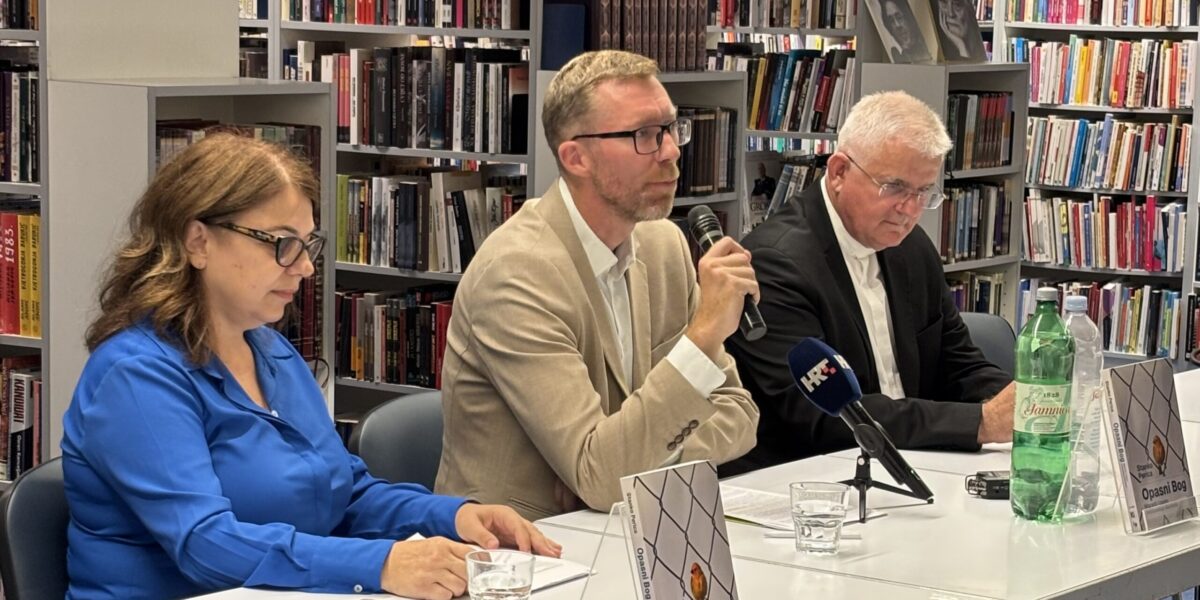
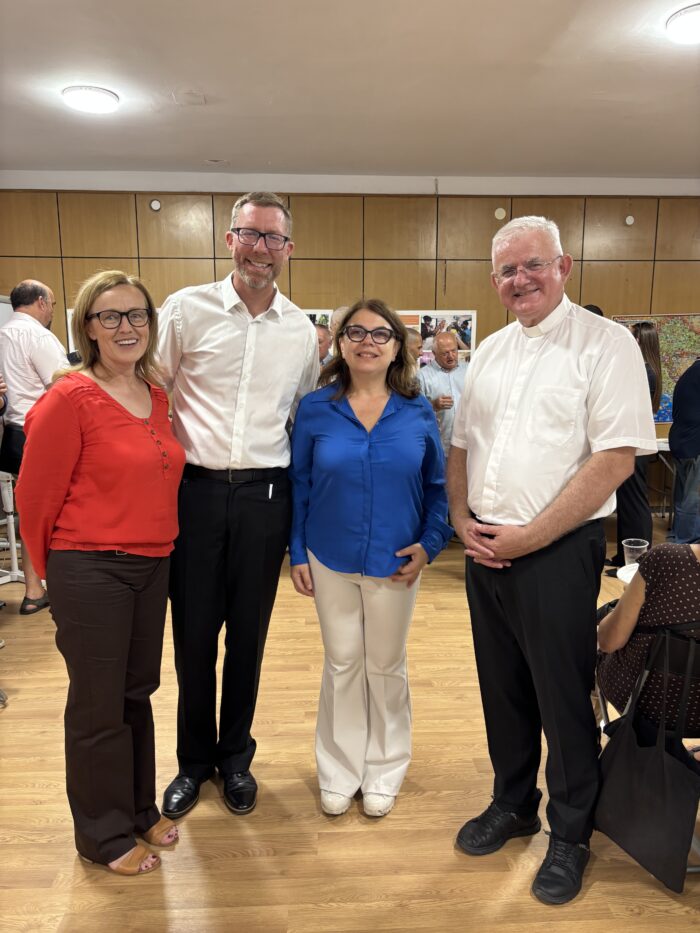
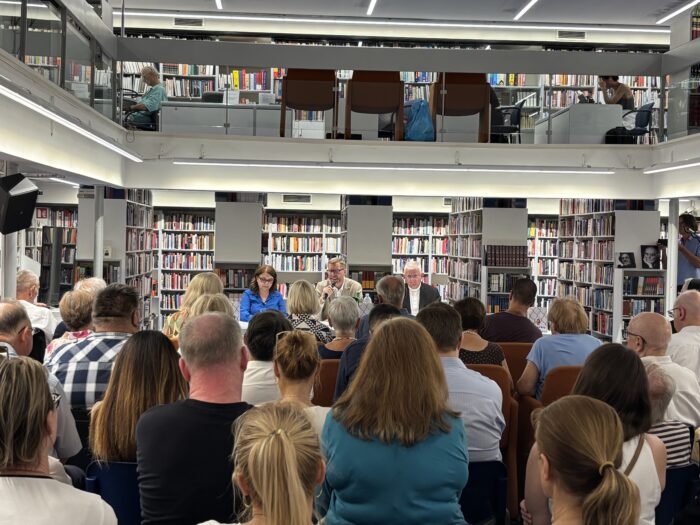
The book Dangerous God – Migrants and the Challenge of Christian Identity by Stanko Perica, former Director of the Jesuit Refugee Service in Southeast Europe, was presented at the Bogdan Ogrizović Library and Reading Room in Zagreb on Wednesday, 26 August. Alongside the author, the book was discussed by Linda Samardžić, who for many years headed the office of the International Catholic Migration Commission in Istanbul, and Mate Uzinić, Archbishop of Rijeka. The presentation was moderated by Blaženka Jančić, editor of the Croatian Radio Religious Programme.
The book was jointly published by Jesenski and Turk, Kršćanska sadašnjost and the Jesuit Refugee Service. At the heart of the evening was the question of how Christian faith can respond to migration as one of the most important social, political and moral issues of the contemporary world, without overlooking either the real challenges brought by migration or the dignity of every human person.
The first speaker was the author, Stanko Perica, who thanked those present for attending, as well as the presenters, publishers, reviewers and his JRS colleagues. Their daily work with migrants, he stressed, confirms that the subject of the book is not merely a field of academic research, but an issue connected with real human lives.
Perica explained that he began to engage more intensively with the subject of migration around ten years ago, while studying theology in Rome. The migration crisis at the time showed him how alive theological questions are and how closely they are connected with reality. The arrival of large numbers of migrants, many of them Muslims, once again raised questions about Europe’s Christian identity, but also about the moral response to people seeking safety and a new beginning.
At first, the humanitarian perspective dominated public discussion of the migration crisis, but it was soon overshadowed by security and economic arguments. This raised the question of whether there was room for a theological perspective, and whether it could offer something more than a general call to kindness. Perica sought to explore whether preserving Christian identity means closing oneself off from others, or whether that identity is affirmed precisely in our relationship with the stranger, the displaced person and those in need.
He sees the book’s scholarly contribution in developing a systematic theological perspective on migration. This approach is not exclusively theological, but brings theology into dialogue with economics, sociology and politics. Migration cannot be properly understood from a single perspective, nor can the complex questions it raises be resolved through simple answers.
Drawing on the Bible, Perica showed that migration is not a marginal theme in the Christian tradition. Abraham leaves his homeland, Jacob experiences exile, Joseph ends up in Egypt, Moses wanders through the desert, and the prophets often live on the margins of society. As a child, Jesus becomes a refugee in Egypt, while the apostles go out among different peoples. The early Church, too, emerged as a community of people of different languages, cultures and backgrounds. The experience of departure, exile, acceptance and hospitality thus runs like a thread throughout biblical history.
The title of the book is connected to Pope Francis’ expression “dangerous God”. It refers to a God who does not always confirm human certainties and preconceived attitudes, but instead calls them into question. Such a God draws people out of self-sufficiency and asks what they will do with the stranger. For Christians, therefore, their relationship with migrants is not merely a political or security issue, but a place where their image of God and the credibility of their faith are put to the test.
Perica did not overlook the right of states to protect their borders, regulate migration flows and adopt laws. He warned, however, that for believers, security, political and economic perspectives cannot be the only ways of looking at migration. A Christian approach must keep the individual person at its centre, together with their dignity and the circumstances that led them to leave their home.
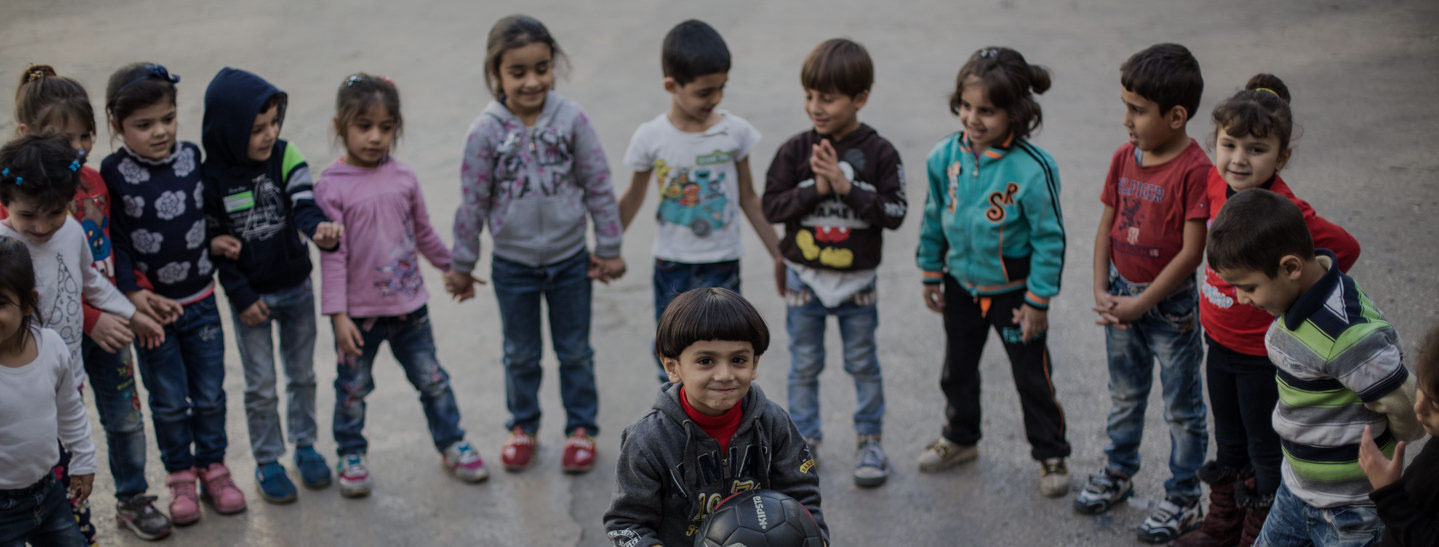
The book is given particular value by research conducted by the author among more than 600 migrants along the Western Balkan route. Perica stressed that migrants are widely discussed in public, but rarely listened to directly. For this reason, he wanted his research to give them a voice and allow them to speak for themselves about their experiences, fears, faith and expectations.
The research showed that for the vast majority of migrants, religion is not merely a private matter, but one of the foundations of their identity. It shapes their relationship with their families, their life decisions and their hopes for the future. Successful integration therefore cannot be reduced to providing accommodation and employment, but must also include building trust, mutual understanding and dialogue. Neglecting the religious dimension of the migrant experience can make the process of becoming part of a new society more difficult and slower.
Perica devoted the final part of the book to a culture of dialogue and interculturality. Unlike assimilation, which expects migrants to give up their own identity, or multiculturalism, in which different communities can live alongside one another without any genuine encounter, an intercultural approach implies a relationship that changes both sides. “Integration is not a process in which only the migrant learns something. The society receiving migrants must also learn,” Perica stressed.
Following the author, Linda Samardžić spoke, drawing on her many years of experience working with refugees and managing resettlement programmes from countries of first asylum to the United States and European Union countries. She gave those gathered an insight into what refugee resettlement means in practice and how demanding the process can be for people who have had to leave their country because of war, persecution or other dangers.
She presented resettlement as one of the safe and legal pathways for protecting particularly vulnerable refugees. It involves more than simply organising travel to a new country; it is a lengthy process that includes interviews with refugees, document checks, security and health procedures, and preparation for life in a new environment. Before departure, refugees receive information about the country they are travelling to, its laws, education system, employment opportunities, cultural differences, and the rights and responsibilities they will have.
Samardžić stressed that resettlement represents a new opportunity for refugees, but also a major change in their lives. Arriving in a safe country does not mean that all difficulties have come to an end. People bring with them experiences of loss, persecution, prolonged waiting and uncertainty, while in their new environment they face an unfamiliar language, a different culture, the search for employment and the challenge of rebuilding their lives. Preparation must therefore go beyond administrative procedures to include cultural orientation and support in developing independence.
In her presentation, she also highlighted the importance of humanitarian corridors and other safe pathways for arrival. Such programmes enable people in need of international protection to avoid entrusting their lives to smugglers and embarking on dangerous journeys. At the same time, they allow states and organisations receiving refugees to prepare in advance for their arrival and provide the support needed for their first steps towards integration.
Her presentation made clear that successful reception does not depend solely on migrants and refugees. The communities receiving them must also prepare. Access to reliable information, quality interpretation, the involvement of local institutions and organisations, and the openness of people who will become neighbours, colleagues and friends to newcomers are all important. Integration is therefore a shared responsibility of refugees, public institutions and the society receiving them. Integration is a genuine encounter between people, and for it to take place, we must never lose sight of the fact that everyone involved is a human being.
Samardžić also shared that her father had to migrate and become a refugee before she was born. Many years later, she found herself sitting on the other side of the table, assessing cases similar to that of her own father. This personal story helped her to keep in mind throughout her work that the person sitting before her was not a case file, but someone’s father, mother, wife, husband, daughter or son.
The final speaker was Mate Uzinić, Archbishop of Rijeka and author of the book’s foreword. He explained his reflection in the foreword that the book comes at a time when migration is widely discussed, but often superficially and irresponsibly, while Christianity is frequently used selectively as a means of justifying closedness and fear of others.
According to the Archbishop, the God described in the book is “dangerous” because he refuses to be a guarantor of our certainties and closed identities. He challenges a form of religiosity that invokes Christianity while at the same time excluding one’s neighbour. The issue of migration thus becomes a place where Christian faith and one’s relationship with God, others and oneself are put to the test.
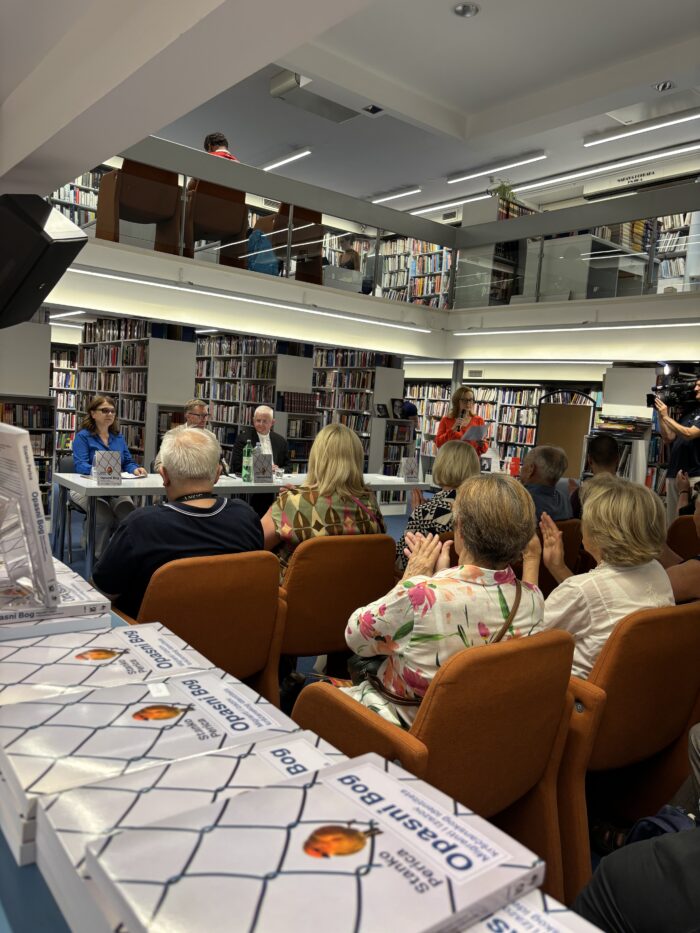
Uzinić warned that migration is neither a passing phenomenon nor a short-term disruption, but a permanent feature of the contemporary world. It is therefore necessary to reflect seriously on the direction in which the Church and society will move. In his view, the book shows that it is possible to preserve one’s own identity while at the same time developing solidarity, openness and creativity in encounters with others.
He particularly emphasised the importance of creating spaces for encounter and using a language of welcome that is neither superficial nor naïve, but demanding and rooted in the Gospel. Drawing on his own experience, he recalled the work of the Migrant Centre in Rijeka, where Caritas of the Archdiocese of Rijeka, the Jesuit Refugee Service and numerous other Church and civil organisations and individuals worked together. This experience showed that a culture of dialogue is not merely a theoretical idea, but a concrete practice that emerges wherever people are willing to cooperate and draw closer to those in need.
Speaking about the different reactions that advocacy for the poor and disenfranchised can provoke in public life, Uzinić recalled the well-known words of the Brazilian Archbishop Hélder Câmara: when he gave food to the poor, he was called a saint, but when he asked why people were poor, he was called a communist. Paraphrasing this thought in relation to his own experience, he observed that he is praised when he helps “our own people”, but when he helps others, such as migrants, he is labelled a “red bishop”.
He stressed that concern for migrants is not opposed to concern for the local population. On the contrary, if we learn how to care for migrants, we will also become better at caring for our own people. A society that develops sensitivity towards the stranger and those in need becomes better able to recognise the needs of the poor, lonely, unemployed and excluded within its own communities.
Uzinić then announced the initiative of the Mediterranean Alliance for Peace, which grew out of the Mediterranean Theological Meetings in Lovran, where, just over a month earlier, participants had reflected on the theme “Prophesying Peace Amid the Noise of War: Peacemaking in an Age of Militarism”. The Alliance is intended as an invitation to join in a shared commitment to peace, one of the fundamental needs of our time. It is open to Christians, Muslims, members of other religions and people who do not belong to any religious community.
The initiative will be based on a document of the same name, consisting of ten commitments for all those who wish to work effectively and consistently for peace. Uzinić also announced the forthcoming launch of a website where the document will be available for signing, along with prayers for peace and other resources related to the Alliance’s ten commitments.
He particularly highlighted the sixth commitment, which concerns advocacy for migrants. It includes supporting every person’s right to remain in their own country and to live there in conditions worthy of human dignity, as well as supporting the integration of migrants and foreign workers into the communities, societies and countries where they have settled.
According to Uzinić, this commitment also expresses one of the central messages of the book presented that evening. We stand with migrants through a responsible way of life that takes into account people living in less fortunate circumstances. This means being informed and recognising our shared responsibility, as well as working to prevent the wars and conflicts that cause refugee crises, along with the environmental and economic crises that force people to leave their homes.
At the same time, we stand with migrants by supporting those who have already become members of our societies, so that they can find their way, become independent and participate in the community as quickly as possible. They need to experience the closeness and support of the society they have joined, rather than being left to face ghettoisation and marginalisation.
Such care requires rejecting and condemning every form of xenophobia, advocating constructive and sustainable migration policies, and adopting an approach that recognises migrants above all as human beings, rather than as a threat.
The Archbishop particularly valued the fact that the book does not speak about migrants without migrants. The research conducted among people along the migration route gives space to their experiences and ensures that they are not viewed merely as numbers, a security problem or a sociological category. In the book, they appear as people whose lives and experiences challenge Christians to reflect on their relationship with God and their neighbour. He added that the book also includes reflections by popes who have confronted the question of migration, encouraging us not to be afraid to think and act in accordance with the Gospel.
He concluded by saying that hospitality and dialogue are not signs of weakness or naïvety. They are demanding ways of living the Gospel and building a society in which the dignity of every person is respected. The direction that the Church and society choose in their response to migrants will therefore say much about the kind of future they wish to build for all their members.